

It’s not unusual to walk out of a veterinary clinic thinking, “That added up fast.” The cost of a vet visit can vary widely depending on why you’re there, where you live, and whether your cat needs tests or treatment.
Because pet medical care isn’t the same as human medical care, the cost of the exam, diagnostics, and care are required to be paid upfront. Pet insurance is available, but it is not legally mandated, nor does it function like human insurance.
Average cost of vet visit for a cat
For a basic exam, cat owners can expect to pay around $50 to $100 for a routine wellness exam or $75 to $150 for a sick visit with a general practice, or primary care, veterinarian. This covers the veterinarian’s times and the physical exam. It doesn’t, however, include any tests, vaccines, or medications your cat may need.
These cost estimates do not apply to seeing veterinary specialists. Animals, like humans, have speciality doctors in various medical disciplines such as cardiology for the heart, dermatology for skin & allergies, and ophthalmology for the eyes. Their exam fees tend to range from $200 to $300 depending on whether baseline diagnostics are included in their initial exam fee.
Overall, for a healthy adult cat, annual vet costs usually range from $200 to $600 per year. This can include:
- Bi-annual wellness exams
- Core vaccines
- Fecal test
- Yearly routine lab work
Kittens and senior cats can cost more due to extra vaccines or diagnostic testing.
Cost breakdown
Below are some general cost charts. Prices can vary by region and clinic type, but this gives you a realistic low-to-high range.
Typical operations
These costs are for your typical veterinary clinic. Low-cost clinics and nonprofits may offer lower prices.
| Procedure | Low | High |
|---|---|---|
| Routine wellness exam | $50 | $100 |
| Sick visit | $75 | $150 |
| Spay (female) | $150 | $500 |
| Neuter (male) | $75 | $300 |
| Deworming | $20 | $75 |
| Bloodwork | $80 | $250 |
| Fecal test | $25 | $70 |
| Urinalysis | $40 | $100 |
Dental
Dental disease is common in cats that don’t receive routine at home dental care and can become expensive if ignored. While humans can hold their mouths open to allow their teeth to be scaled safely, animals cannot. It is recommended that cats have their teeth cleaned with their veterinarian annually unless otherwise instructed. This allows the dental tartar, or plaque, to be removed on the teeth that you can see and below the gum line where you cannot see.
The costs of a dental cleaning depends heavily on anesthesia, X-rays, and if there are diseased teeth that need to be addressed. In many cases, diseased teeth have to be removed, or extracted. In some cases, the teeth can be saved, but these more complicated tooth-saving procedures should be done with a veterinary dental specialist. Below are the estimated costs of dental cleanings with your primary care veterinarian.
| Procedure | Low | High |
|---|---|---|
| Professional dental cleaning | $300 | $800 |
| Tooth extraction (per tooth or added cost) | $50 | $300+ |
Imaging
Most general practice primary care veterinarians have the ability to perform radiographs, or X-rays. Some may have the ability to do ultrasounds as well. Both of these diagnostics may be able to be performed without any sedation on kitties that are calm. Oftentimes, performing these tests can be scary; so some cats need sedation or even immobilization to be able to get accurate results.
Beyond these, advanced imaging is usually performed at specialty hospitals, which increases the cost. CT scans & MRIs require animals to be completely still. The only way to do that is to put them under general anesthesia; so a lot of the increase in cost is due to the anesthesia required to perform the tests.
| Procedure | Low | High |
|---|---|---|
| X-ray | $100 | $600 |
| Ultrasound | $300 | $900 |
| CT scan | $800 | $2,000+ |
| MRI | $1,500 | $3,500+ |
| Echocardiogram | $500 | $1,000 |
Emergency treatments
Emergency clinics charge more because they often employ veterinary specialists who have additional training in emergency medicine. They also operate overnight, on weekends, and with specialized staff. It is not uncommon to find that many of the recommended treatments can be performed at your primary care veterinarian for a fraction of the cost, but be reminded that the difference in cost is due to the emergent nature of the condition and the additional training of the staff.
| Procedure | Low | High |
|---|---|---|
| ER exam fee | $100 | $250 |
| After-hours visit | $150 | $300+ |
| Emergency surgery | $1,000 | $5,000+ |
End-of-life
Euthanasia is a service offered by most general clinics and emergency veterinary hospitals. You will typically be given a few options regarding what is done with the remains of your newly departed family member. If you opt to have them cremated, the actual cremation may be outsourced to a specialty provider. Many vet offices also offer the option to have a clay paw made as well and customizations to the urn if the decision is made to do a private cremation.
| Service | Low | High |
|---|---|---|
| *Exam/office fee | $50 | $150 |
| Euthanasia | $100 | $300 |
| Sedation | $25 | $100 |
| Private cremation | $150 | $400 |
| Communal cremation | $50 | $150 |
| Clay paw print | $35 | $100+ |
*Some veterinary facilities have to charge an exam or office visit fee to assess the patient prior to performing the euthanasia.
The “realistic bill” examples
Seeing itemized examples can help make the numbers feel more real. Here are a few:
1. A wellness checkup
- Exam: $75
- Vaccines: $60
- Fecal test: $40
Total: ~$175
2. A sick visit (UTI symptoms)
- Exam: $95
- Bloodwork: $180
- Urinalysis: $80
- Medication: $45
Total: ~$400
3. An ER visit for vomiting/lethargy
- ER exam fee: $175
- X-rays: $350
- IV fluids: $200
- Medications/injections: $150
- Bloodwork: $250
Total: ~$1,125
What changes the price the most?

Several factors can dramatically increase the cost of a vet visit:
- Location – Urban areas typically cost more than rural areas.
- Clinic type – Specialty hospitals and ER clinics charge more than general practices.
- Timing – Nights, weekends, and holidays increase fees.
- Diagnostics – Bloodwork, imaging, and anesthesia add up quickly.
- Follow-ups and medications – Initial visits may only be part of the total cost.
- Size of the patient – Fees for larger animals may be higher
Pet insurance: costs & is it worth it
An average monthly premium for young, healthy cats can range from $15 to $40 per month while older cats are more expensive at around $40 to $70 per month. Premium prices depend on:
- Age
- Breed
- Location
- Coverage level
- Deductible choice
Most plans will reimburse you anywhere from 70% to 90% after you meet your deductible.
However, most pet insurance plans won’t cover everything. Some items that are often excluded from pet insurance are:
- Pre-existing conditions – Any illness or injury your cat had before the policy started typically isn’t covered, even if symptoms come back later.
- Some dental procedures – Many plans exclude routine cleanings or limit coverage to dental accidents rather than disease-related treatments.
- Waiting periods before coverage begins – Most policies require you to wait a set number of days (sometimes weeks) before certain conditions or injuries are eligible for reimbursement.
- Wellness care – Unless a wellness plan is added on, routine services like vaccines, annual exams, and preventive medications aren’t included in standard coverage.
When is pet insurance worth it?
Pet insurance is very valuable in cases of the unknown and unexpected. While many general practice veterinary offices offer “wellness plans” of sorts, many of them do not cover diagnostics or treatments in cases of sickness. An ear infection can cost you $200-$500 depending on the severity of the infection. If your cat faces a $2,000 emergency bill and insurance reimburses 80%, you may only pay $400 plus your deductible. Over time, insurance can be helpful for high-cost, unexpected events, especially ER visits or surgery.
It’s less valuable if you only use routine care and your cat stays otherwise healthy. The true determination of value is based on your financial preparedness as a pet parent. Most veterinarians highly recommend investing in pet insurance.
How to lower the cost (without skipping needed care)
- Ask for an itemized estimate
- Ask what’s “must-do now” versus what can wait
- Compare local clinics
- Look for nonprofit or vaccine clinics
- Explore vet school clinics or community organizations
- Ask about payment options like CareCredit or payment plans
- Keep up with routine care to avoid ER visits
Emergency cost planning (when you can’t wait)
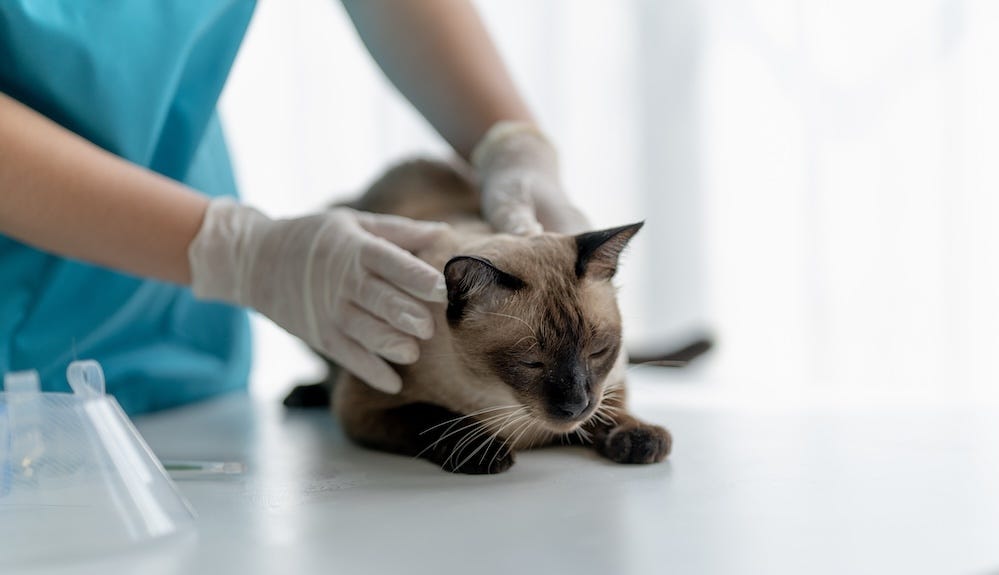
Some situations can’t wait for an appointment with your regular vet. Head to the emergency vet if your pet has:
- Trouble breathing or choking
- Severe bleeding that won’t stop
- Collapse or inability to stand
- Seizures
- Suspected toxin ingestion (chocolate, medications, household chemicals, etc.)
- Repeated vomiting or diarrhea, especially with lethargy
- A bloated or painful abdomen
- Trauma (hit by car, fall, animal attack)
Emergency vets are designed to stabilize pets quickly, which means diagnostics and treatment often happen at the same time. After the exam fee, your cat may immediately receive bloodwork, X-rays, IV fluids, pain medication, or hospitalization for monitoring. ER clinics also operate overnight, on weekends, and with specialized staff and equipment, which increases overhead costs. The combination of urgent testing, around-the-clock care, and advanced equipment is why emergency bills can climb so much faster than standard daytime clinic visits.
FAQ
How much is a vet visit for a cat without insurance?
Typically $50 to $150 for the exam alone, but tests and treatments add to the total. That being said, most pet insurances won’t cover the cost of a general exam unless you have a wellness add-on with your policy.
How much does a cat X-ray / ultrasound / CT / MRI cost?
X-rays cost around $100 to $600 depending on how many images are needed, ultrasounds are around $300 to $800 depending on the area of the body, and a CT/MRI can cost upwards of $800 to $5,000 depending on size of the patient and the area(s) of focus.
How much does it cost to neuter a cat?
Neutering costs $75 to $500 on average, depending on the clinic.
How much does it cost to put a cat to sleep?
It usually costs $100 to $300 for a cat euthanasia, plus optional aftercare services.
How much does it cost to deworm a cat?
Around $30 to $75 depending on medication and testing.
How much is pet insurance for a cat?
Most pet insurance plans range from $15 to $70 per month depending on your cat’s age and the coverage requested.